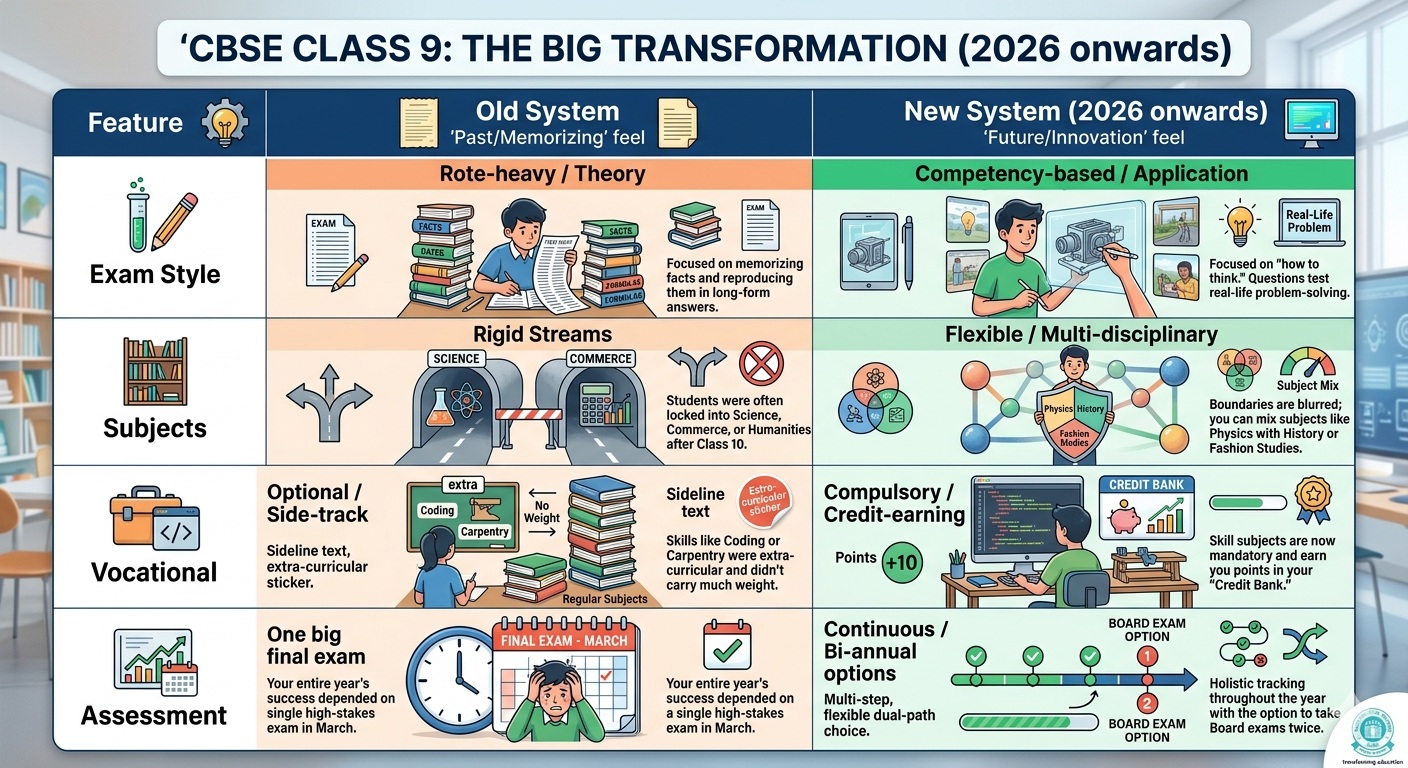
The academic session 2026–27 marks a major transformation in the CBSE Class 9 curriculum. As the Central Board of Secondary Education fully implements the National Curriculum Framework for School Education (NCF-SE) 2023, the new syllabus is not just an update; it is a complete shift in how students learn, think, and apply knowledge.
This change focuses on conceptual clarity, real-life application, and skill development, moving away from rote learning.
If you are a student, parent, or educator entering this new session, here is everything you need to know about the massive changes.
A Shift from “What to Learn” to “How to Learn”
One of the most defining features of the 2026–27 curriculum is its philosophical shift. Instead of focusing solely on what students should study, the new system prioritizes how they learn and apply knowledge.
This means:
- Learning through experience rather than repetition
- Encouraging curiosity and questioning
- Building problem-solving and analytical skills
Education is now designed to make students active participants, not passive learners.
What’s New in the CBSE Class 9 Curriculum?
The redesigned curriculum is structured into eight key areas, including languages, mathematics, science, social science, art education, physical education, vocational education, and interdisciplinary learning.
The goal? To create confident, curious, and future-ready learners who are not just academically strong but also creative, physically active, and skill-oriented.
1. The Three-Language Formula (R1, R2, R3)
Moving away from the two-language system, Class 9 students will now engage with three languages.
The Rule: At least two of these three languages must be native to India.
The Levels: Languages are now categorised by proficiency:
R1: Primary language (advanced level).
R2: Secondary language (intermediate level).
R3: Third language (foundational level).
This phased rollout means that while the 2027 board exams will be the last for the old policy, the 2026-27 Class 9 batch will be the pioneers of this multilingual approach.
2. Two-Level System for Maths and Science
Following the success of "Basic" and "Standard" Mathematics, CBSE is expanding this concept by introducing advanced topics like Arithmetic Progression (AP) and Geometric Progression (GP) earlier than before. The two-level system for maths and science is
- Standard Level: The mandatory foundation for all students (80 marks).
- Advanced Level (Optional): A separate 25-mark paper (1 hour) designed for students who want to test their Higher Order Thinking Skills (HOTS).
- Good news: Your scores from the Advanced exam won't count toward your main overall grade, but they'll appear as a "special qualification" on your marksheet. This is beneficial for those aiming to take competitive exams like JEE or NEET.
Science is now more practical and application-based. There are fewer chapters, but each one goes into more detail to help you understand better. The curriculum now puts more emphasis on experiments, understanding data, and real-world problems like health and sustainability. This makes learning more useful and important. It also adds new topics, like simple machines and updated ideas in biology, to build on what you already know. The goal is for students to learn how to think like scientists, not just memorise facts.
3. Social Science: Making Learning Meaningful
Social Science is now designed to be more engaging, relevant, and closely connected to real life, making learning both meaningful and interesting. The curriculum features streamlined chapters with greater clarity and depth, as well as advanced and relevant topics such as ancient civilizations, geological processes like plate tectonics, and democratic systems and governance. It also places strong emphasis on civic responsibility, ethical thinking, and global awareness. As a result, students will develop a deeper understanding of society and governance, and recognize their role as responsible and informed citizens
4. The New "Kaveri" Textbook and the Death of Rote Learning
If you look at the new English textbook, Kaveri, you’ll notice something immediately: the stories aren't just there for you to summarize. The questions are now "competency-based".
Instead of asking, "What did the character do?", they’ll ask, "Given the character's personality, how would they react to a modern-day problem like climate change?" You can’t find those answers in a guidebook. You actually have to understand the themes.
The curriculum focuses on the development of all four key language skills—reading, writing, listening, and speaking—ensuring a well-rounded approach to communication.
Why It’s Important:
By strengthening these abilities, students gain the confidence to express their ideas clearly and effectively. This not only enhances their academic performance but also equips them with essential communication skills required for future careers and real-world interactions.
The "IKS" Factor (Indian Knowledge Systems)
Social Science and Science are getting an "Indian makeover." You’ll see a lot more references to ancient Indian metallurgy, traditional water harvesting, and Vedic mathematics. It’s not just about history; it’s about looking at how ancient Indian logic can solve modern-day problems.
Your Hobbies are now "Credits"
This is perhaps one of the most exciting changes introduced through the National Credit Framework(NCrF), as it brings a “gamified” approach to school life. Under this system, every activity a student engages in earns credits.
- Academic Learning: Earns you credits.
- Playing Football or Yoga: Earns you credits.
- Coding or Carpentry: Earns you credits.
These credits are recorded in a “Credit Bank,” recognising and valuing all forms of effort equally. It ensures that a student dedicating time to music, sports, or skill-based learning is acknowledged just as much as one focused on academics, promoting a more balanced and inclusive approach to education.
Assessment Reforms: Rethinking Exams
The traditional exam system is evolving to reflect better students’ understanding and skills rather than their ability to memorize information. Key changes include the introduction of two-level exams, especially in Mathematics and Science, as well as the possibility of open-book assessments that test real understanding. Greater weightage is also being given to internal assessments, projects, and classroom activities. As a result, exams will shift from rote learning to focusing on interpretation, application, and logical reasoning, making evaluation more meaningful and practical.
Why These Changes Matter
This new curriculum aims to:
- Reduce exam stress
- Build critical thinking and creativity
- Prepare students for Class 10, competitive exams, and real life
- Encourage independent learning and decision-making
Challenges to Expect
- New textbooks may be delayed initially
- Students may find the syllabus more challenging at first
- Teachers and students both need time to adapt
The CBSE Class 9 Curriculum 2026–27 is a bold and progressive step in Indian education. It transforms classrooms into spaces where students don’t just study; they explore, question, and grow.
If you’re entering Class 9, get ready for a journey that’s less about mugging up and more about understanding life itself.