Every year, thousands of students and parents find themselves stuck on the same question: Should you go with the Central Board of Secondary Education (CBSE) or the Indian Certificate of Secondary Education (ICSE)? It sounds like a big, life-defining decision, and honestly, it can feel a little overwhelming.
But here’s a different way to look at it: this isn’t about choosing the “best” board. It’s about choosing the right environment for how you learn, grow, and plan your future.
Because CBSE and ICSE aren’t rivals trying to outdo each other; they’re two different systems designed for two different kinds of learning experiences. One leans toward clarity and exam readiness, while the other focuses on depth and expression.
So instead of asking, “Which one is better?" let's explore what each one actually offers and which one feels like the right fit for you.
Understanding the Basics
The Central Board of Secondary Education (CBSE), aligned with the NCERT Framework, is a national-level board followed by thousands of schools across India and abroad. It is known for its structured and streamlined curriculum.
On the other hand, the Council for the Indian School Certificate Examinations (CISCE), which conducts ICSE exams, is recognized for its comprehensive and detailed approach to education.
Pedagogy and Syllabus: Structured Learning vs Detailed Exploration
When comparing the Central Board of Secondary Education (CBSE) and the Indian Certificate of Secondary Education (ICSE), one of the most noticeable differences lies in how they teach (pedagogy) and what they teach (syllabus).
Pedagogy (Teaching Approach)
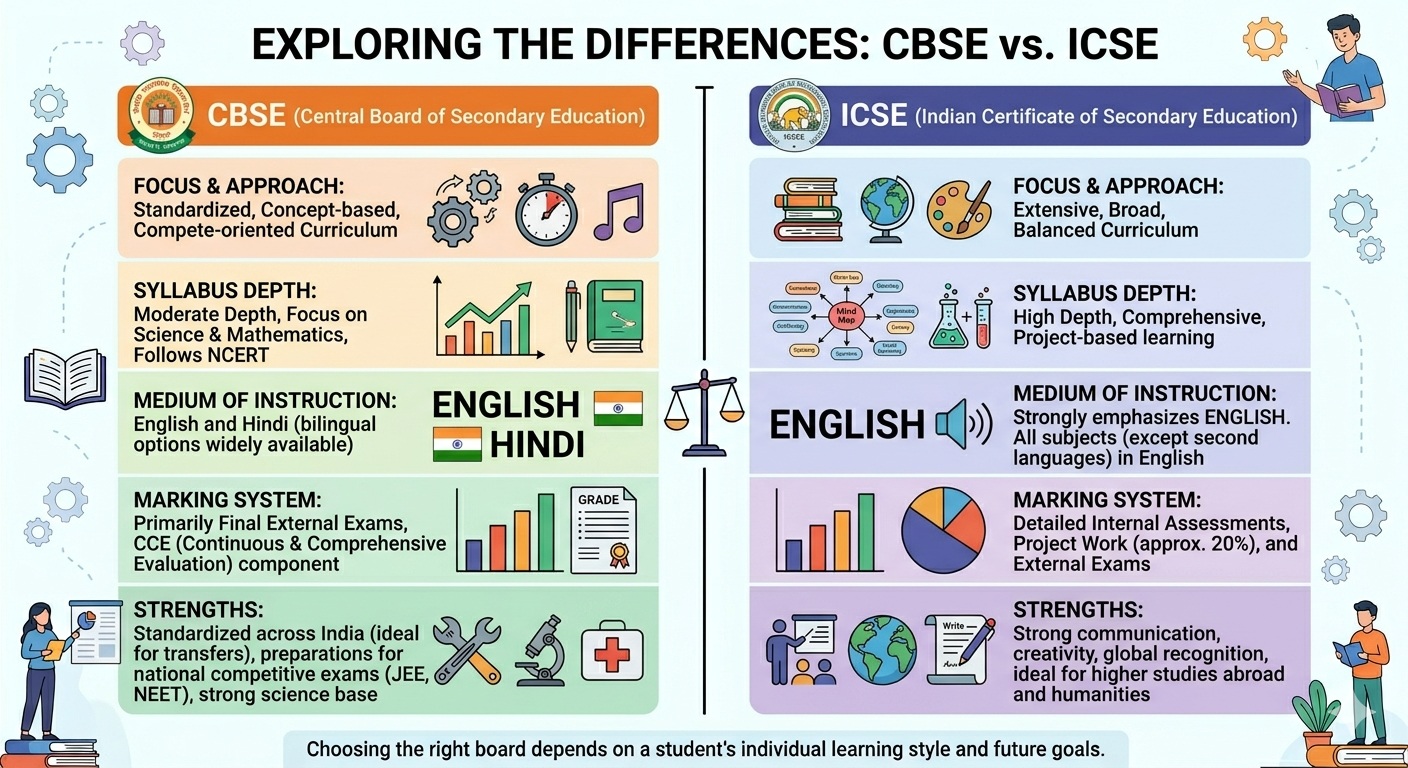
The Central Board of Secondary Education (CBSE) follows a structured and concept-focused teaching style. Lessons are designed to be clear, concise, and aligned with exam requirements. Teachers often emphasize understanding key concepts and practicing questions that are likely to appear in exams. In recent years, CBSE has also introduced more competency-based questions, but the overall approach remains exam-oriented and efficient.
In contrast, the Indian Certificate of Secondary Education (ICSE) uses a more interactive and application-based teaching method. It offers a massive, diverse syllabus that places equal weight on Humanities, Arts, and Sciences. If your child is a natural "why-seeker" who enjoys deep-diving into literature and complex projects, ICSE offers the necessary depth. The focus is not just on learning answers but on developing analytical thinking, creativity, and communication skills. This makes the learning experience more engaging and exploratory.
Syllabus (What You Study)
The syllabus of the Central Board of Secondary Education (CBSE) is compact and well-defined. It avoids unnecessary details and focuses on core topics, especially in Science and Mathematics. This makes it easier for students to revise and manage their studies, particularly during board exams and competitive exam preparation.
On the other hand, the Indian Certificate of Secondary Education (ICSE) offers a more detailed and extensive syllabus. Subjects are covered in depth, with additional emphasis on language, literature, and internal assessments. While this can feel heavier, it helps students build a strong conceptual understanding and a broader knowledge base.
The 2026 Shift: Assessment Styles
With the implementation of the National Education Policy (NEP) 2020, both the Central Board of Secondary Education (CBSE) and the Indian Certificate of Secondary Education (ICSE) have started evolving their assessment patterns. However, even with these changes, their core “testing DNA” still feels very different.
CBSE’s New Flexibility
In 2026, the Central Board of Secondary Education has taken a significant step by introducing a two-board exam system for Class 10. This reduces the pressure of a single high-stakes exam and gives students more flexibility to improve their performance.
At the same time, CBSE has shifted strongly toward competency-based questions. Instead of simply asking students to recall definitions, exams now focus on how well they can apply concepts to real-life situations. This marks a move away from rote learning toward practical understanding.
ICSE’s Analytical Edge
The Indian Certificate of Secondary Education has always stood out for its emphasis on internal assessment, and this continues to be its strength.
A significant portion of a student’s final grade comes from:
- Lab experiments
- Fieldwork and reports
- Creative and research-based projects
This approach encourages students to think independently, research deeply, and express their ideas clearly. Over time, it builds a strong analytical and inquiry-based mindset, which is especially valuable in higher education and global academic environments.
Future-Proofing: Where is the Destination?
Choosing between CBSE and ICSE isn’t just about school; it’s about where you’re headed in the future. Your career goals can help make this decision much clearer.
Here’s how each board aligns with different paths:
| If the goal is... | The board will consider... | Why? |
| Engineering / Medical (India) | CBSE | Syllabi for JEE and NEET are directly mapped to CBSE/NCERT textbooks. |
| Management / Law / Humanities | ICSE | Offers superior language grooming and a broader social science foundation. |
| Studying Abroad | ICSE | Recognized globally for its rigorous English standards and comprehensive project work. |
| Civil Services (UPSC) | CBSE | The foundational books for UPSC are the same NCERT books used in CBSE schools. |
Medium of Instruction
The Central Board of Secondary Education does not place a strong preference on any one language and offers flexibility in the medium of instruction, making it suitable for a wide range of students.
In contrast, the Indian Certificate of Secondary Education places a strong emphasis on English language and literature, which can be beneficial for exams like TOEFL and IELTS, as well as for developing communication skills and overall personality.
Overall, ICSE’s focus on language helps students become more confident in expression, while CBSE provides greater linguistic flexibility.
Skill Development
- CBSE builds a strong foundation in problem-solving and conceptual clarity.
- ICSE enhances language proficiency, analytical skills, and detailed understanding.
A Snapshot of Difference:
| Feature | CBSE | ICSE |
| Parent Body | Central Board of Secondary Education (Govt.) | Council for the Indian School Certificate Examinations (Private) |
| Focus | Strong foundation in Science & Math; standardized | Holistic development; emphasis on language & arts; detailed |
| Textbooks | Mostly NCERT | Variety, chosen by schools; comprehensive |
| Syllabus | Streamlined and concise | Vast and detailed |
| Exam Style | Objective and factual | Descriptive, application-based |
| Relocation | Generally easier (due to uniform syllabus) | More challenging (syllabi may vary slightly) |
| Competitive Prep | Generally considered more conducive for engineering/medical | Provides strong base for humanities and global education |
| Medium | English and Hindi | English primary |
Final Thoughts
Choosing between the Central Board of Secondary Education and the Council for the Indian School Certificate Examinations is less about finding the “better” board and more about finding the right fit.
CBSE offers a focused, streamlined path ideal for students aiming at competitive exams and structured learning. ICSE, on the other hand, provides a richer, more detailed academic experience that builds strong language skills and conceptual depth.
Ultimately, the board alone does not determine success. A student’s interest, consistency, and willingness to learn play a far greater role. With the right mindset, students from both boards can achieve equally strong outcomes and build successful futures.