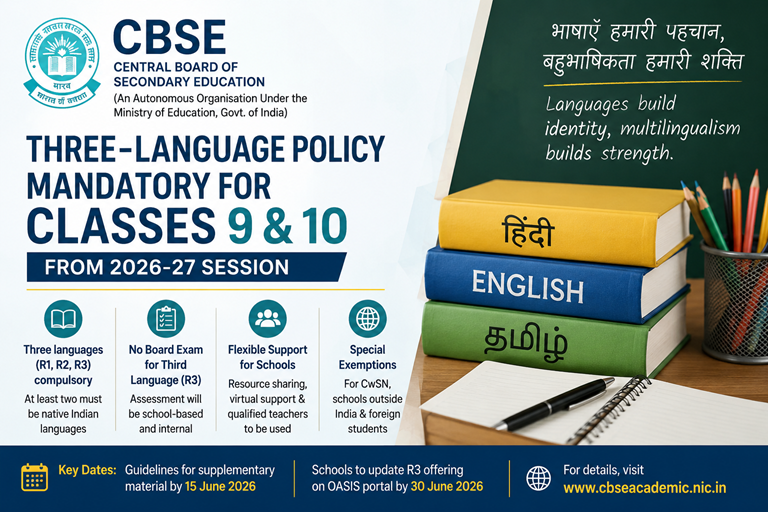
In a significant move to align school education with the National Education Policy (NEP) 2020 and the National Curriculum Framework for School Education (NCF-SE) 2023, the Central Board of Secondary Education (CBSE) has announced a restructured Scheme of Studies for languages in Classes IX and X
According to Circular No. Acad-33/2026 issued on May 15, 2026, students entering Class IX from the 2026-27 academic session onwards will be required to study three languages (R1, R2, and R3), with at least two of them being native Indian languages.
Key Highlights of the New Policy
Under the revised scheme:
- The three-language system will become compulsory for Class IX students from July 1, 2026.
- Students may choose a foreign language only if the other two selected languages are native Indian languages.
- Foreign languages may also be studied as an additional fourth language.
CBSE stated that the move is aimed at strengthening multilingual learning and promoting cultural rootedness among students.
Transitional Approach for Schools
Because the current academic session kicked off in April 2026, CBSE is adopting a transitional approach to map its curriculum smoothly to the newly released NCERT syllabus.
A comparative analysis by the board revealed a 75-80% overlap in core language competencies (such as oral communication, reading comprehension, written expression, and grammatical awareness) between the Middle Stage and Secondary Stage R3 level. Consequently, until dedicated Secondary Stage R3 textbooks are published, Class IX students will utilise the Class VI R3 textbooks (2026-27 edition).
To bridge any curriculum gaps, schools must supplement these textbooks with local or state literary materials, including:
- Short stories
- Poems
- Non-fiction works
CBSE will release comprehensive pedagogical and selection guidelines for these supplementary materials by June 15, 2026. Class VI R3 textbooks for 19 scheduled languages, including Assamese, Bengali, Gujarati, Marathi, Odia, Punjabi, Tamil, and Telugu, will be distributed to schools before July 1. For other native Indian languages, schools can continue using existing SCERT and state-level resources. Schools have been directed to update their language offerings on the OASIS portal by June 30, 2026.
No Board Exam Pressure for Third Language
In a major relief for students and parents, CBSE clarified that there will be no Class X Board Examination for the third language (R3).
Instead:
- Assessment for R3 will remain completely school-based and internal.
- Student performance will still appear on the CBSE certificate.
- No student will be barred from appearing in Class X board exams due to R3 requirements.
The Board said the decision was taken to ensure “joyful and meaningful language learning” without adding examination stress.
Support for Schools Facing Teacher Shortages
Recognising potential challenges, CBSE has allowed schools flexibility in arranging teachers for native Indian languages. Schools may:
- Use teachers from other subjects with language proficiency
- Share resources through Sahodaya school clusters
- Conduct virtual or hybrid classes
- Engage retired language teachers or qualified postgraduates temporarily
Exemptions and Special Provisions:
The circular outlines distinct exemptions to ensure inclusivity and accommodate exceptional cases
- Children with Special Needs (CwSN) shall be granted relaxations as per the RPwD Act, 2016 (including exemption from second and/or third language where applicable).
- CBSE schools situated outside India.
- Foreign students coming back to India may be granted case-by-case exemptions from the requirement of two native Indian languages.
The administration emphasised that these provisions are designed to protect student interests, ensuring that the transition fosters joyful, meaningful multilingual proficiency rather than academic stress.