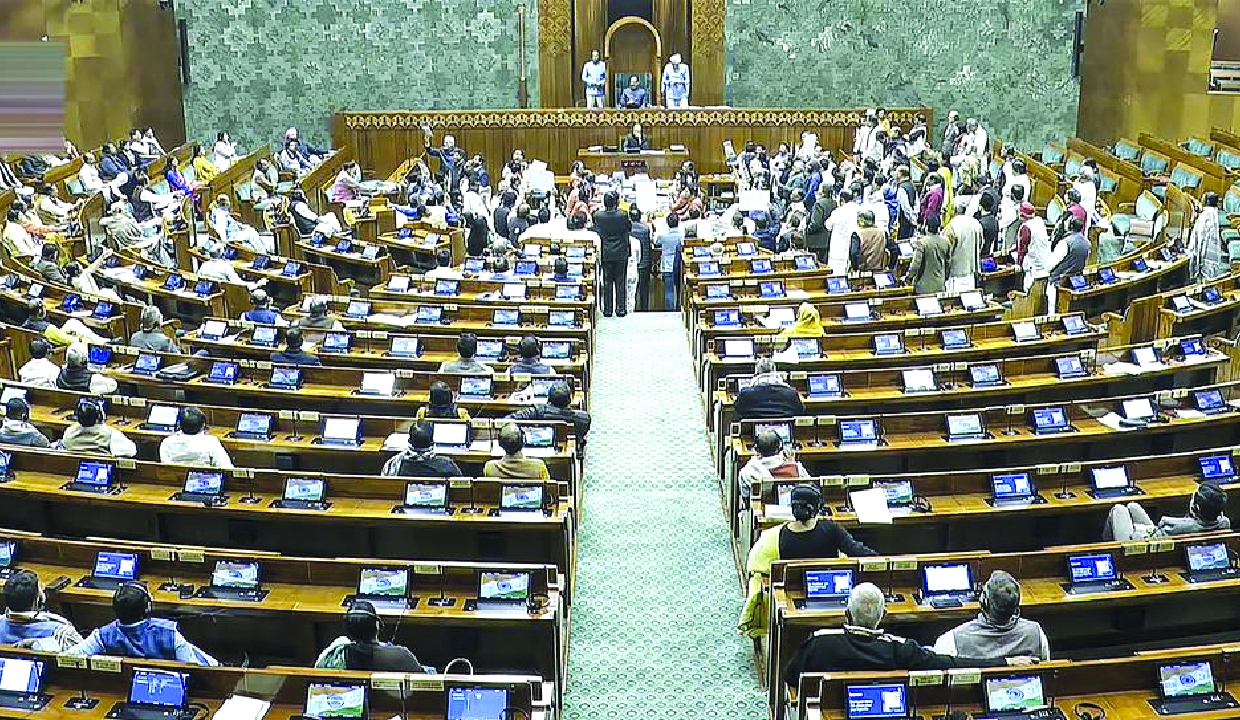
A parliamentary panel has drawn attention to a steep fall in the number of schools and students as education levels rise, with nearly 73% of students leaving before completing higher secondary. The findings are part of the Tenth Report (Eighteenth Lok Sabha) of the Committee on Estimates (2026-27) on budget and policy aspects for affordable and quality education, presented in the Lok Sabha on Wednesday.
According to the Unified District Information System for Education (UDISE) 2024-25, among 10,92,671 government and government-aided schools, 9,11,032 are at the primary level, 4,12,805 at upper primary, 1,61,808 at secondary, and only 90,866 at higher secondary. Student enrolment also drops sharply, from 6,18,45,033 in primary classes and 4,08,93,978 in classes 6 to 8, to 2,36,68,220 at secondary and 1,64,17,949 at higher secondary.
The committee expressed concern over this drastic decline, noting that out of over one million government schools, the vast majority are only primary schools. It urged the Education Ministry to prioritise upgrading existing primary and secondary schools into full higher secondary schools to ensure physical access and reduce dropout rates.
Since education is on the Concurrent List, with most schools under state and Union Territory jurisdiction, the committee recommended that the ministry encourage states and UTs to establish more secondary and higher secondary schools.
The panel also flagged a gap between curriculum design and implementation for classes 9 to 12. It noted that CBSE had aligned its curriculum framework for these grades with the National Education Policy (NEP) 2020 and the National Curriculum Framework (NCF) 2023. However, NCERT is still rolling out new textbooks, so schools often teach an updated, high-order curriculum while older materials remain in use.
This mismatch, along with newer application-based Board examination patterns, is creating significant academic stress and confusion, especially for students appearing in Class 10 and 12 exams. The committee urged the ministry to speed up the development, printing, and nationwide distribution of the remaining new textbooks.
It also recommended that NCERT work with CBSE to ensure successful implementation of new initiatives and suggested a nationwide teacher-capacity building programme to train educators in application-based pedagogy.
Source: EduSaint
