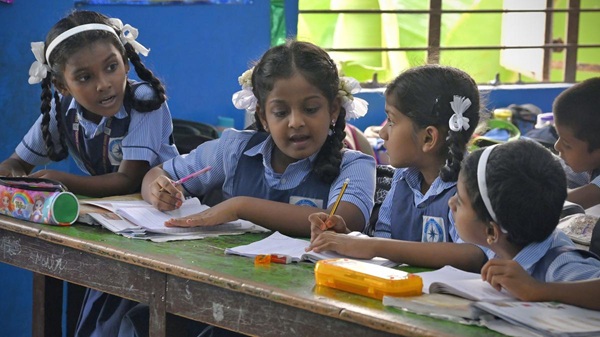
A major political and social controversy has emerged in Puducherry following a directive from the Central Board of Secondary Education (CBSE) to implement the National Curriculum Framework for School Education. The revised framework enforces a strict three-language formula starting from Class 6, requiring students to study two native Indian languages and only one foreign language. Since English is already classified as a foreign language and serves as the medium of instruction in almost all local CBSE schools, the new policy effectively forces the removal of French from the school curriculum. This sudden disruption has triggered widespread protests across the Union Territory.
Chief Minister N. Rangasamy addressed the escalating tensions during the inauguration of the newly reconstructed 200-year-old Pensionnat Government Girls’ French High School on Dumás Street. The school was rebuilt under the Smart City project at a cost of ₹7.5 crores, preserving its historic colonial architecture. Speaking at the event, the Chief Minister categorically assured that the government is actively taking steps to ensure French continues as a core subject in local schools. He emphasized that French is inextricably linked to the cultural fabric of the Union Territory.
“Many people in Puducherry desire to learn French, and it is our duty to protect this historical legacy. I have officially written a letter to the Central Government strongly urging them to grant an exemption and retain the French language in Puducherry schools. The local administration will continue to take all necessary steps to facilitate French education,” the Chief Minister stated.
The CBSE’s tight implementation window has left schools scrambling, causing acute panic among stakeholders. Groups of students, parents, and teachers have organized silent protests across Puducherry. Protesters highlighted the “abrupt discontinuity” faced by students who have been dedicatedly learning French since primary classes. Parents expressed deep anxieties over their children’s academic futures, while teachers raised grave concerns about sudden livelihood insecurity for the region’s long-serving French educators.
Opposition political parties, including the DMK and Congress, have united against the three-language policy, terming it a deceptive attempt at linguistic imposition that forces Hindi or Sanskrit onto a unique territory. Local leaders pointed out that the 1956 Treaty of Cession signed between India and France legally guaranteed that the French language would remain official and that the distinct French educational curriculum would be permanently preserved. Political factions are demanding that the Centre honor this historical treaty and allow French to be recognized as a local option language, citing its immense value for global employment and higher education.
The linguistic row has resonated internationally. Coinciding with Prime Minister Narendra Modi’s recent official diplomatic visit to France for the G7 Summit and VivaTech 2026, members of the expatriate Puducherry French community staged a high-profile starvation protest in France. The hunger strike aimed to draw global attention to the systemic erasure of their native region’s unique cultural memory and colonial history. Closer to home, the Bharati Foundation has launched a massive grassroots signature campaign throughout the Puducherry region. The foundation aims to gather thousands of endorsements from citizens, scholars, and local activists to formally petition the Union Ministry of Education, demanding that French be permanently safeguarded as an integral part of the curriculum.